Yesterday, I went to two restaurants in the same day. I mention this because this is not typical for me at all. In fact, I don't think this has happened in Oxford before.
First, Merissa invited me, along with Victor and Molly, to Edamame, a Japanese restaurant, for lunch. I had the best miso soup I have ever had. It was a giant bowl of miso broth with chicken, noodles, and veggies. Sometimes these Asian soups are really bland, but this was delicious.
Then, for dinner, I went out with Victor, Molly, and Heidi to a Thai restaurant on High Street. It was decent, but they were all in a rush to get back to the house for the 6:45 episode of Dr. Who. I had chicken pad thai. It was fine.
For a while I felt bad about eating out twice in one day, but today I realized that I still have plenty of my meal allowance money from two weeks ago. And we're getting more money tomorrow. Considering we traveled to Edinburgh last weekend, I'm wondering how I managed to spend so little over the past two weeks.
The other thing I did yesterday was answer a bunch of emails, many of which were from AEPi pledges. It came to the end of their pledge period, and, as every year, they scrambled to get their meals with all of us. (If you didn't know, every pledge is expected to get a meal with every active AEPi brother. There are penalties for each meal missed.) In my case, a "meal" is basically an email exchange where we introduce ourselves to each other. After several weeks of pledge and several weeks of hardly hearing from any pledges, I got half a dozen emails over a few days and responded to them all yesterday. That took up a bunch of time.
Other than that, I watched Dr. Who, and, as you might have noticed, also spent a sizable amount of time catching up on some blogging. I'm in the process of writing several more necessary posts about my last couple weeks of life. They are not yet ready for posting, though.
Oh. And I did some [academic] work.
Sunday, May 22, 2011

Saturday, May 21, 2011
2nd Trip to London
On our second tour of London, we looked at parks and public spaces, mainly in Westminster and the West End. London was behind much of Europe at planning public spaces for the people of London. The 17th and 18th centuries saw the construction of many squares around London, especially in the more affluent areas. Westminster, which used to be a separate city farther west on the Thames, and the West End were areas inhabited mainly by the wealthy in those centuries, which is why they got some of the best building and planning. The idea of city parks came a bit later. London was essentially the first city to put parks in the middle of the city. A couple centuries ago, England was really into landscape architecture, and those ideas migrated from the countryside estates to London. New York, San Francisco, and pretty much every other city with public parks can thank London for that idea.
After the tour, Elizabeth, Kendra, Aileen, and I went to the British Museum for about 25 minutes before we had to head back to Oxford. I will be back soon and spend more time there.

View of the Buckingham Palace from St. James's Park

View of the Horse Guards at St James's Park (view is 180 degrees from the view above)

Lawn chairs to rent at St. James's Park

Aileen petting a pelican

Carleton House Terrace
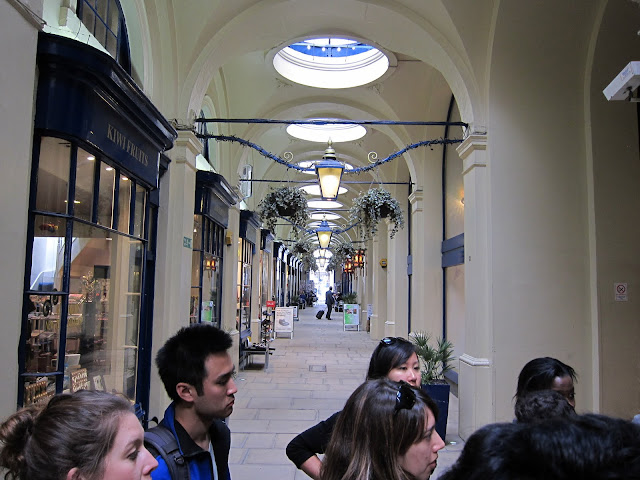
The Royal Arcade - the first covered market in London

221 Baker Street - where Sherlock Holmes lived in the books

Regent's Park

Regent's Park. Note how it's really really big. To the right you can see the group, with Geoffrey Tyack about to explain something awesome.

Outside the British Museum. L to R: Elizabeth, Kendra, Aileen, Me

The Rosetta Stone! I had actually seen this before.

Aileen, Kendra, and I spent 25 minutes quickly running through the Egypt and Assyrian sections of the museum.
After the tour, Elizabeth, Kendra, Aileen, and I went to the British Museum for about 25 minutes before we had to head back to Oxford. I will be back soon and spend more time there.

View of the Buckingham Palace from St. James's Park

View of the Horse Guards at St James's Park (view is 180 degrees from the view above)

Lawn chairs to rent at St. James's Park

Aileen petting a pelican

Carleton House Terrace

The Royal Arcade - the first covered market in London

221 Baker Street - where Sherlock Holmes lived in the books

Regent's Park

Regent's Park. Note how it's really really big. To the right you can see the group, with Geoffrey Tyack about to explain something awesome.

Outside the British Museum. L to R: Elizabeth, Kendra, Aileen, Me

The Rosetta Stone! I had actually seen this before.

Aileen, Kendra, and I spent 25 minutes quickly running through the Egypt and Assyrian sections of the museum.
3rd History & Architecture of Oxford Tour
The third tour of Oxford focussed on the influence of the Renaissance on Oxford architecture. The Renaissance was basically a return to the architectural ideas of ancient Greece and Rome. They incorporated Roman-style arches and columns among other things into a new sort of architecture. My whole History of London paper from a couple weeks ago, which I put in an earlier post, was on this topic. Examples in Oxford of Renaissance influence came from St. John's Canterbury Quad, Wadham College, and the Bodleian Library.

The Divinity School. This room served as the sanatorium in the Harry Potter movies. It has some of the most elaborate ceilings I have ever seen. The work is done in the Perpendicular Gothic (not Classical) style. Note the elaborate fan-vaulted ceiling.

An unauthorized photograph of the Bodleian Library. That guy sitting in the box yelled at us for taking photographs afterwards.

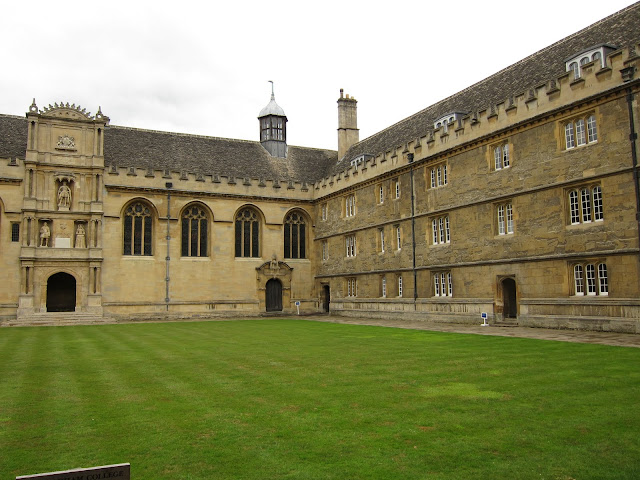
The quad of Wadham College. You can see a tower very similar to the one above.
 St. John's Canterbury Quad. Again, you can see circular Roman arches and plenty of Roman columns. Above the statue of the college's founder, you also see a pediment in the rounded French style. England got many of its Renaissance ideas through France.

This is at Wadham College, but it could be at any other. Nearly every college has a bunch of lawns that nobody is allowed to walk on. Sometimes there are even lawns where only college fellows can walk on them. Sometimes there are specific hours during which you can walk on the lawns. Sometimes you can walk on the lawns only if you are within a set distance of a fellow of the college.

The Divinity School. This room served as the sanatorium in the Harry Potter movies. It has some of the most elaborate ceilings I have ever seen. The work is done in the Perpendicular Gothic (not Classical) style. Note the elaborate fan-vaulted ceiling.

An unauthorized photograph of the Bodleian Library. That guy sitting in the box yelled at us for taking photographs afterwards.

The Tower of the Five Orders.
The five orders the name of the building refers to are the five orders of Classical architecture. (http://en.wikipedia.org/wiki/Classical_order) You can see examples of all five styles in the five stories of the buildings. The columns framing the tower show the orders in order of elegance, from bottom to top: Tuscan, Doric, Ionic, Corinthian, and Composite. The three basic Greek orders are Doric, Ionic, and Corinthian. Tuscan is similar to Doric, but even plainer. Composite combines the ornaments of the Ionic and Corinthian orders to produce the most elaborate order.

The quad of Wadham College. You can see a tower very similar to the one above.


This is at Wadham College, but it could be at any other. Nearly every college has a bunch of lawns that nobody is allowed to walk on. Sometimes there are even lawns where only college fellows can walk on them. Sometimes there are specific hours during which you can walk on the lawns. Sometimes you can walk on the lawns only if you are within a set distance of a fellow of the college.
Fluxus Tour
Below are photos I took during the "Fluxus Tour." This was a tour around Oxford put on by the students in Mark Applebaum's Trans-Idiomatic Arts Practicum class. The students were tour guides, but most, if not all, of what they said was spurious. They made up histories, stories, and facts about various locations that were very entertaining. It was kind of like a spoof of a tour.

This is Chase

Alexis

L to R: Chelsea, Alex, Heming, Aileen, Alexis, Brittany, Laura (with the face), Christine

Kelly

Heidi Sigua

Professor Mark "Mapplebaum" Applebaum.
A few words on Professor Applebaum: This man is really really cool. He is a music professor at Stanford, but has produced art of all shapes and sizes in his time. He really cares about his students and is really passionate about the things he teaches. He has a tendency to talk at long length about anything, because he has a tendency to be really interested in everything. I don't think we could have gotten a better visiting professor.

Heidi Thorsen

Lucas

This is Chase

Alexis

L to R: Chelsea, Alex, Heming, Aileen, Alexis, Brittany, Laura (with the face), Christine

Kelly

Heidi Sigua

Professor Mark "Mapplebaum" Applebaum.
A few words on Professor Applebaum: This man is really really cool. He is a music professor at Stanford, but has produced art of all shapes and sizes in his time. He really cares about his students and is really passionate about the things he teaches. He has a tendency to talk at long length about anything, because he has a tendency to be really interested in everything. I don't think we could have gotten a better visiting professor.

Heidi Thorsen

Lucas
2nd History & Architecture of Oxford Tour
This post is a bit late. We did this 10 days ago, on May 11. This class visited Merton College, the first of the Oxford colleges, and New College, which set a sort of standard for collegiate architecture in the centuries to come.

The quad at Merton College.

The chapel at Merton College.

The outside of New College. The wall next to the parked cars is part of the original city walls. That means it dates back almost 1000 years.

The quad at New College.

Our tour this week was led by David, our TA. Around him are Eric (looking up), Libby (in the back), Anthony (can't see his face), Minsuk (looking down), and Lily (looking away).

The dining hall at New College.

The chapel at New College.
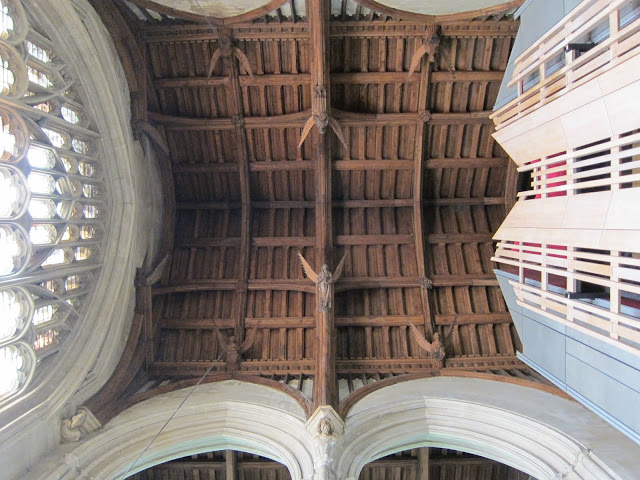
Ceiling of the chapel. Note the winged angels.

Particularly nice stained glass in the chapel.

Cloister of New Chapel.

In the quad, looking towards the library of New College.

From left to right: Lisa, Minsuk, Lily, Tara, Eric.

The storefront of my favorite deli.
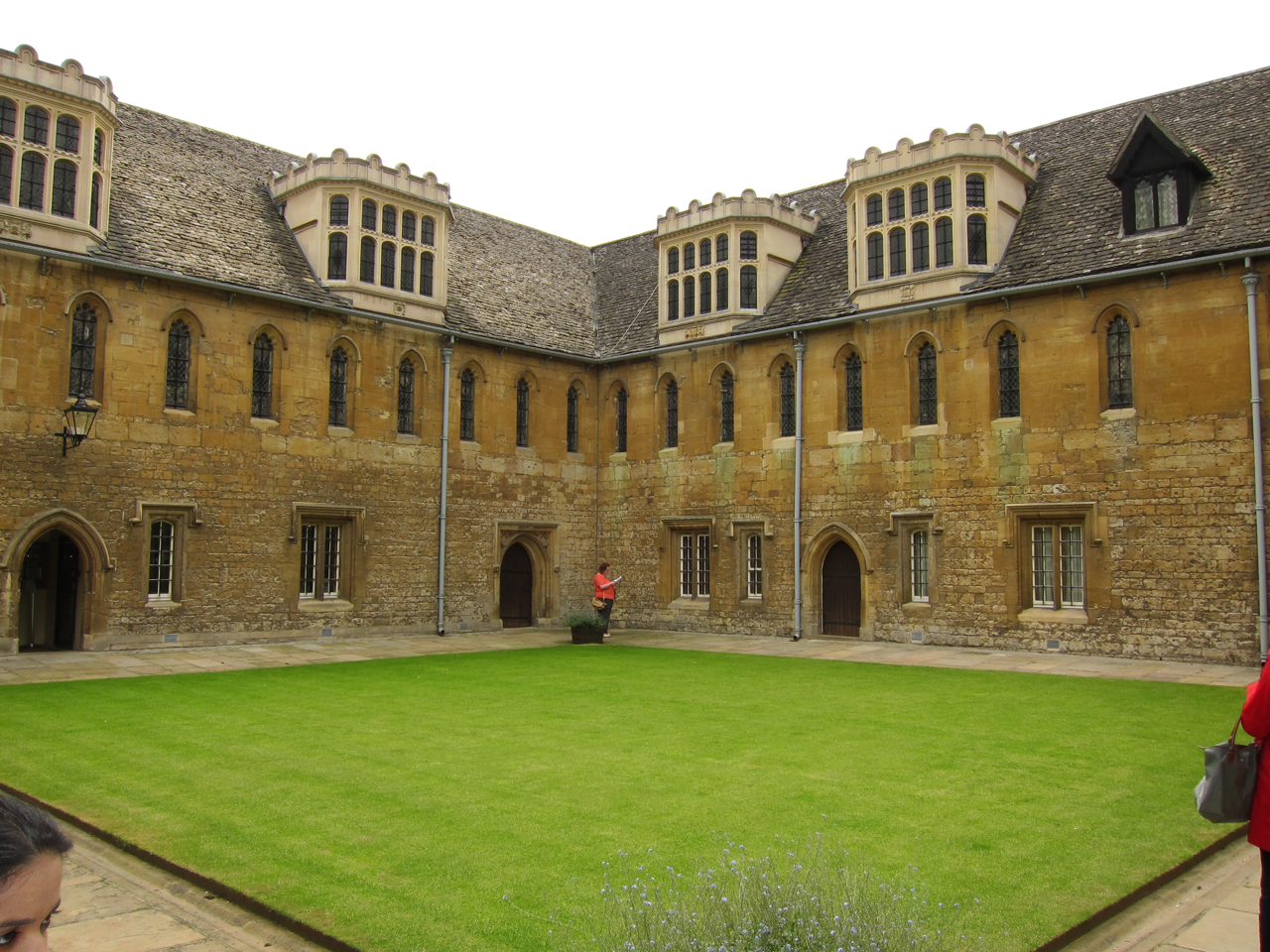
The quad at Merton College.

The chapel at Merton College.

The outside of New College. The wall next to the parked cars is part of the original city walls. That means it dates back almost 1000 years.

The quad at New College.

Our tour this week was led by David, our TA. Around him are Eric (looking up), Libby (in the back), Anthony (can't see his face), Minsuk (looking down), and Lily (looking away).

The dining hall at New College.

The chapel at New College.

Ceiling of the chapel. Note the winged angels.

Particularly nice stained glass in the chapel.

Cloister of New Chapel.

In the quad, looking towards the library of New College.

From left to right: Lisa, Minsuk, Lily, Tara, Eric.

The storefront of my favorite deli.
Thursday, May 19, 2011
A Promise to Post More
I promise to post more than I have been.
Overall, I am unimpressed with how I've been living life this past week, aside from Edinburgh, which was great. I don't know if I have stopped posting because I felt worse about things this past week or if I felt worse about things because I wasn't posting about them. It's probably a combination of the two. But I want to break the cycle now.
Since the last real post, I have had a couple really good (bad) ideas that I want to write about. They both involve higher education of sorts. The first I already wrote briefly about. The second is an idea for a more radical alternative/supplement to college that focuses on self-teaching and sharing knowledge. Basically, it would be like an exclusive apartment complex. More on those later.
Tomorrow, I have to get up early to go to London for my second London field trip. This time I plan to wake up on time.
Also, I promise more pictures soon. I have hundreds to go through, but I will get on it. I am thinking about entering some of the better ones in the Bing Overseas Programs photo contest. Unfortunately, there is no cash prize - just a shirt, a water bottle, and the calendar the winning entries will be put in.
Sunday, May 15, 2011
Just back from Edinburgh, Scotland
Hi Blog and (maybe) Readers,
I flew back from Edinburgh, Scotland, today. It was our Bing Trip, so nearly everyone in the Stanford program went. I was without internet for a few days, so - I'm sorry - I haven't been blogging. I don't have time or energy to detail the trip. Long story short: the trip was fantastic. Edinburgh is a beautiful, amazing city, and everyone on the Stanford program is great company. I feel lucky to have such good travel partners. I took a ton of pictures, some of which I will upload later, after I pick out the best ones. For now, I'll just copy our itinerary.
All the best,
Me
Rosslyn Chapel
Edinburgh Castle
The Palace of Holyroodhouse
The Scottish Parliament
The National Museums of Scotland
I flew back from Edinburgh, Scotland, today. It was our Bing Trip, so nearly everyone in the Stanford program went. I was without internet for a few days, so - I'm sorry - I haven't been blogging. I don't have time or energy to detail the trip. Long story short: the trip was fantastic. Edinburgh is a beautiful, amazing city, and everyone on the Stanford program is great company. I feel lucky to have such good travel partners. I took a ton of pictures, some of which I will upload later, after I pick out the best ones. For now, I'll just copy our itinerary.
All the best,
Me
BING GRANT TRIP TO EDINBURGH
13 to 15 MAY 2011
Friday, 13 May:
6.30 a.m. Be at Queens Lane Coffee House to store luggage onto coach –
look for the Motts coach - to depart no later than 6.40 a.m.
7.45 a.m. Arrive Heathrow, Terminal 5
8.50 a.m. Flight No. BA1438 Shuttle leaves Heathrow to Edinburgh
10.10 a.m. Arrive Edinburgh – look for Abbot Travel coach to take us to –
11.15 a.m. Rosslyn Chapel - no guided tour, but information available.
12.30 p.m. Depart Rosslyn to drop off luggage at the Premier Inn, Haymarket –
Luggage will be stored until later check-in.
Lunch on your own [beer and baked potato with coleslaw]
2.15 p.m. Meet Guides on Grassmarket for a walking tour of Old Town - split
into 3 groups. The tour will end at –
4.00 p.m. Edinburgh Castle. Entry as a group.
6.00 p.m. Walk back to the Premier Inn and check into hotel rooms.
7.00 p.m. Dinner at the hotel.
Saturday, 14 May:
9.30 a.m. Meet in hotel foyer to take a local bus to –
10.00 a.m. Palace of Holyroodhouse. This visit is optional, but entry will be
covered only for the students who attend at this time. [I attended]
10.30 a.m. First group meets at the Scottish Parliament for guided tour.
10.50 a.m. Second group meets at the Scottish Parliament for guided tour.
11.10 a.m. Third group meets at the Scottish Parliament for guided tour. This
group will include those who visited the Palace of Holyroodhouse. [This was my tour]
Security check-in takes approx. 30 minutes and the tour lasts approx.
1 hour.
FREE TIME after tours have finished for the rest of Saturday. [Tried Scottish salmon, Scottish beer, and Scottish haggis, which was surprisingly good. Then hiked to the top of Arthur's Seat (http://en.wikipedia.org/wiki/Arthur's_Seat,_Edinburgh). Had dinner, more beer and baked potato, this time with beans and cheese, at a tavern.]
7.10 p.m. ‘Ghosts and Ghouls’ walking tour – for those signed up. Meet in
front of St. Giles Cathedral on the High Street (Royal Mile). [Did this too]
Sunday, 15 May:
9.15 a.m. All luggage must be cleared from hotel rooms - to be left in
the hotel storage facility for collection later.
9.30 a.m. Meet in hotel foyer to walk to the –
10.00 a.m. National Museum of Scotland or the National Galleries of Scotland or
the Museum of Modern Art – no guided tours. [went to the National Museum of Scotland]
Lunch on your own. Allow 30 minutes to walk back to the hotel by -
12.15 p.m. Collect luggage from the Premier Inn and leave for -
2.00 p.m. Abbotsford House
4.00 p.m. Leave Abbotsford for Edinburgh airport –
6.15 p.m. Board BA1459 Shuttle to Heathrow
7.40 p.m. Land at Heathrow. Motts coach will collect us to return to -
9.00 p.m. Oxford
INFORMATION ABOUT VENUES BEING VISITED IN EDINBURGH
Rosslyn Chapel
The Chapel was founded in 1446. Sir William St. Clair, 3rd Prince of Orkney, perhaps feeling that heaven was uncomfortably close at hand, decided to “build a house for God’s service, of most curious work …… that it might be done with greater glory and splendour.”. If you look high up inside, a series of shields denotes the foundation. Evidence was uncovered in excavations of the 19th century that the original plan was to build something far more extensive than exists today, probably in cruciform shape. It took over 40 years to complete, but on William’s death in 1484 it seems that no further work on the Chapel was carried out. One of its most intriguing features, and that for which it is justly famous, is the intricate and extensive stone carving on walls, columns, pillars, etc., some of which is both curious and elaborate.
The Chapel suffered at the hands of the Reformers in the 16th century, when its altars were destroyed. It ceased to be used as a place of prayer and fell into disrepair. It was finally restored in the mid-18th century, and set in its wild landscape, soon became the haunt of writers and artists. Sir Walter Scott’s poetic work ‘Lay of the Last Minstrel’, is based upon the myth that the building appears as if on fire at night when a Rosslyn Baron dies. Dorothy Wordsworth is known to have visited it and described it as ‘exquisitely beautiful’, but it wasn’t until Queen Victoria’s visit in 1842 that it was designated to ‘be preserved for the country’. It was rededicated as a place of worship in 1862, and has been serving as such ever since.
Edinburgh Castle
70 million years ago, the volcanic rock on which Edinburgh Castle stands was formed by glacial movement, which forged a deep indent running from the rock down to the bottom of today’s Royal Mile and out into the Firth of Forth. Recent archaeological excavations suggest that Bronze Age Man lived on this rock as long ago as 900 BC and an Iron Age hill fort settlement definitely existed on the summit 2,000 years ago.
The oldest part of the existing castle is a tiny chapel, constructed in the early 12th century in memory of Queen Margaret, wife of Malcolm III. The Castle began its life as a Royal fortress soon after, during the reign of David I, 1124-1153. During the next 300 years, the castle grew in importance. James III in the mid-late 15th century extended the castle significantly while it served as his permanent home. The last monarch to stay in the castle was Charles I in 1633. Thereafter, it served as a military base only, being used by Oliver Cromwell as his military headquarters in the mid-17th century, and was never again breached, despite attacks by the Jacobites in 1715, and Bonnie Prince Charlie’s army in 1745. Although the castle had not seen military action since then, it was further fortified during the late 18th century in reaction to the threat of invasion from Napoleon’s armies.
In 1818, Sir Walter Scott was given permission to search for the Honours of Scotland (the Crown, Sword and Sceptre) and discovered them in a chest in a room in the deepest part of the castle where they had been hidden in 1707. From this time on, the castle has been a major tourist attraction, although it still serves as a military barracks. Visitors can see the Crown Jewels today and the Stone of Scone or The Stone of Destiny, the traditional coronation stone of Scottish kings and queens before it was stolen by Edward I of England in the 13th Century and placed in Westminster Abbey. The Stone is surrounded by mystique and mystery, there being various versions of its origin and history and students are encouraged to explore both for themselves.
The Palace of Holyroodhouse
The legacy of Queen Margaret, who was canonised after her death, lives on in Holyroodhouse. Legend has it that David I, her son, founded an Augustinian Abbey on the site in 1128, following a vision in which a cross, or “rood”, belonging to his mother appeared between the antlers of an attacking stag. The Abbey flourished and in 1501, James IV of Scotland cleared land alongside the abbey and built a palace for himself and his bride, Margaret Tudor, sister of Henry VIII of England. Holyroodhouse became the preferred residence of the next two generations of Scottish kings.
It’s most famous inhabitant was Mary, Queen of Scots, who lived in the Palace for a large part of her adult life. She married two of her husbands in the Abbey and her secretary, David Rizzio, was murdered in her personal rooms by a group led by Lord Darnley, her throne-aspiring husband, who thought she was having an affair with Rizzio.
Mary’s son, James VI of Scotland, and later James I of England, spent more time in London than in Edinburgh, and the Palace of Holyroodhouse fell into decline. It was renovated on his brief return to Scotland in 1617 and further improved to mark the Scottish coronation of his son, Charles I, in 1633. Cromwell ‘s troops were billeted there following the execution of Charles I, and the Palace suffered from significant fire damage. Following the restoration of the monarchy, Charles II, although he never lived there, initiated substantial rebuilding.
The Scottish Parliament
Between the Act of Union in 1707, which brought Scotland into the United Kingdom and gave it 45 seats in the new British House of Commons, until the Scotland Act of 1998, Scotland did not have the constitutional right to run its own Parliament, even though, in many respects, the country continued to operate a separate legal and administrative system. The Scotland Act 1998 was implemented and the first Scottish Parliament elections held in May 1999.
The Scottish Parliament is housed in an innovatively designed complex series of buildings that the architect, Enric Miralles, describes as “sitting in the land”. Leaf-shaped extensions, upturned boats, concrete “branches” covered in grass, extensive use of wood and water, and gabion walls of stone taken from buildings previously occupying the site, all sit in landscaped parkland which “flows” into the surrounding hills. Justice is probably best done to the design when the buildings are viewed from above.
The National Museums of Scotland
The Royal Museum, worth visiting for its magnificent glass ceiling, houses international collections of artefacts, covering subjects relating to nature, art, science and culture.
The Museum of Scotland tells Scotland’s story, through its history, its politics and its people. It is housed in an award-winning, but some might say, controversial building designed by Benson & Forysth Architects of Edinburgh. It was built as an extension to the Royal Museum, and focuses entirely on Scotland’s history and culture.
Abbotsford House
Abbotsford is the house built and lived in by Sir Walter Scott, the 19th century novelist, and author of timeless classics such as Waverley, Rob Roy, Ivanhoe and The Lady of the Lake.
Sir Walter Scott purchased Cartleyhole farmhouse on the banks of the River Tweed in 1812. Together with his family and servants, he moved into the farm which he renamed Abbotsford.
Scott had plans for enlarging the house which were not carried out until 1818, and in 1822 the old house was entirely demolished, to be replaced by the main block of Abbotsford as it is today.
Scott was a passionate collector of historic relics, including an impressive collection of armour and weapons, Rob Roy's gun and Montrose's sword, and over 9,000 rare volumes in his library.
We shall be able to see Sir Walter Scott’s study, library, drawing room, entrance hall and armouries, and the dining room overlooking the Tweed where Sir Walter died on 21st September, 1832. The walled garden is very attractive and the lawns sloping down to the river offer ample opportunity to get closer to the stunning views.
There is a small café by the entrance for hot and cold drinks and snacks.
Ghosts and Ghouls Tour
This has been arranged for Saturday evening, starting at 7.15 p.m., for those who have signed up in advance. If anybody decides on the day that they also wish to attend, please let Rebecca know.
Most of the tour takes place underground, in the dark, and by repute, is not for the faint-hearted. Wear walking shoes, and a coat, because it gets chilly.
Subscribe to:
Posts (Atom)