Wednesday, May 11, 2011

Renaissance Architecture in C17 and C18 London

The last several days have been wrapped up in this:

The Impact of the Renaissance on the Architecture and Urban Planning of 17th and 18th Century London


As England grew in power and esteem over the seventeenth and eighteenth centuries, London, its capital city, physically transformed in response. Renaissance ideas of architecture from fifteenth and sixteenth century Italy, which had already been adopted around the European Continent, found increasing favour in London, as the former town began to assert itself as one of the world’s great cities. The architecture that evolved in Europe at the end of the Middle Ages drew on ancient Rome’s laws of proportion and architectural features. This mixed with a desire “to create a modern, enlightened, Christian architecture,”[1] producing Renaissance Classicism.

According to John Summerson, in London, “taste was a luxury import from abroad.”[2] However, by 1600, “England was the only major European country to which an Italian architect had not been called to design a building.”[3] Taste for Renaissance architecture came to London at the beginning of the 17th century, when there were noblemen and artists in the royal courts who had visited Florence, Milan, and Venice and finally became interested in building Italian buildings in England. Over the following two centuries, Renaissance ideas would transform the face of London.


For purposes of discussion, the two centuries of architectural history can be crudely broken into three distinct periods defined by events and personages. The first period extends from the beginning of the seventeenth century to the Great Fire of 1666. The second period follows Christopher Wren’s career from the rebuilding of London to the turn of the century. The third period constitutes the bulk of the eighteenth century. Within all of these are myriad important events and people, but none are as important in this context as the Great Fire and Wren.


Similarly, buildings influenced by Classicism can be divided into four categories: churches, halls of livery companies and municipalities, houses of ordinary people, and great houses of the Crown, aristocracy, and gentry[4]. To varying extents, but over every one of the three periods, Renaissance ideas of architecture and urban planning changed how all of these types of buildings were built until, after two centuries, the physical appearance of London was dominated by Renaissance style.


The Seventeenth Century to the Great Fire of 1666


At the beginning of the seventeenth century, Renaissance architecture was almost entirely foreign to London. There were a few instances of Classicism in London. Sir Thomas Gresham, the Queen’s agent in Antwerp, was impressed by the Antwerp Exchange and built the Custom House (1559) and the Royal Exchange in Cornhill (1566-1570) with designs and materials from Flanders[5]. The first man to truly bring Italian Classicism to England, however, was Inigo Jones, and he defined this period. In 1615, after his second visit to Italy, he became Surveyor to the King. Summerson writes, “He knew, probably, more about Italian design than any Englishman living.”[6] His main influence was Andrea Palladio (1508-1580), whose style he brought to London[7]. However, “Jones’s influence did not really take hold of English architecture till nearly a century after his most important works were finished.”[8] When the Civil War removed Charles I from power, it also removed Jones from his job.


Great Houses in the Early Seventeenth Century


Kings James I and Charles I both had appetites for Classical architecture, and Jones worked under both of them. Two of Jones’s major projects were the Banqueting House at Whitehall in 1622 and the Queen’s House at Greenwich Palace[9]. Charles was interested in bringing Italian architecture to the suburbs of London as well, so he built a large house in Lincoln’s Inn Fields in 1640[10]. Lindsey House, as it was known, is a distinctly Jonesian design, though its builder is unknown. “It became the classic statement of the form which a London house-front should take.”[11]


Churches in the Early Seventeenth Century


Inigo Jones was less active in ecclesiastical construction. Churches during this period were undergoing many repairs, which were done both in Gothic and Classical styles[12]. Jones advised the rebuilding of St Michael-le-Querne in 1638-1640, but “his advice appears to have been less than welcome.”[13] At the centre of one of his main works, the Covent Garden Piazza, was St Paul’s. He designed this church on a “big Italian scale,” like a “noble Tuscan temple.”[14]


Houses in the Early Seventeenth Century


The impact Jones had on London houses would not be seen until much later. Ordinary houses made up the bulk of the city, but were not ornate or designed by architects. Aristocrats, who brought in Classicism, lived on the fringes of the City,[15] and the designs of Jones were “neither comprehensible nor particularly welcome to the normal Englishman.”[16] However, Jones’s Piazza at Covent Garden would be the inspiration for the many squares built in London years later. The idea for a square was distinctly Renaissance. The Earl of Bedford, who built the Piazza, probably had the Parisian Place des Vosges in mind when he commissioned Jones[17].


Halls of Livery Companies and Municipalities in the Early Seventeenth Century


Jones did not contribute much in Classical style to this type of building. Though the trading companies were having a great impact on England, Bradley and Pevsner write, “Special architecture for the great new trading companies does not at first seem to have been necessary.”[18] One notable project was a collaboration with Nicholas Stone on the Goldsmith’s Hall (1635-1638), where he employed “Artisan Mannerism” designs from the Italian architect Serlio[19].


Rebuilding After the Great Fire to the Eighteenth Century


The Fire that burned down 13,200 houses, 436 acres, or five sixths of the City[20] allowed one of England’s most notable architects to reshape the city with Renaissance ideas. Christopher Wren, an Oxford professor of astronomy turned architect, spent 1665 and 1666 visiting Paris, looking at buildings and meeting architects, some Italian, and he came back inspired with Renaissance ideas of architecture[21]. Charles II, a great admirer of Louis XIV[22] made Wren royal architect in 1669, and Wren became the “leader of English architecture” for an unprecedented sixty years[23]. He developed a brand of Classicism termed “English Baroque” that became more widely adopted than Jones’s Palladian[24]. Although Wren’s urban plan for rebuilding the City, a Baroque scheme that would have radically changed the City layout, was rejected in favour of keeping the old plan[25], Wren turned most types of building architecture sharply towards Classicism during this period.


Churches in the Rebuilding Period


Only 22 out of 107 London churches survived the Fire. Wren was made part of the Royal Commission for rebuilding and, in the Rebuilding Act of 1671, was put in charge of rebuilding 51 of the churches and St Paul’s Cathedral. Here, Wren tried his hardest to implement Renaissance ideas, many of which were carried out. All of the churches were rebuilt in a Classical style. Wren’s churches gave London its steeple-studded skyline. By 1701 there were many more tall spires than before 1666[26]. The steeple designs were extremely varied, drawing mainly from Classical sources like Borromini and Baroque but also Gothic ones[27]. However, Wren’s original imagination put the churches at the ends of vistas or in piazzas, visions from the Renaissance, but none were[28].


Wren’s masterpiece was the New St Paul’s Cathedral, but it was built with much frustration on his part. Wren’s Great Model (1673), which was inspired by St Peter’s in Rome, was based on a Greek Cross design and had a large dome, was rejected. His Warrant Design (1675), very similar to the Old St Paul’s, was approved but had a tall spire over a low dome and a long cross floor plan[29]. Wren, as part of his goal of equalling Rome and Paris, later reinstated the dome, a “Renaissance innovation,” making Renaissance architecture the fixture of the London skyline for centuries[30].


Halls of Livery Companies and Municipalities in the Rebuilding Period


Nearly one hundred halls were rebuilt in the City, and, unlike the churches, their designs were not guided by a commission and usually not done by architects[31]. The masons and carpenters used much Classical detail, but “made little contribution to the development of London architecture.”[32] Wren worked with Edward Jerman, the City Surveyor, on rebuilding the Royal Exchange, which carried Flemish influence from Gresham[33]. Wren and his fellow scientist-architect, Robert Hooke, added a 202 foot fluted Doric column to the London cityscape as a monument to the Great Fire[34]. He also worked with Nicholas Hawksmoor on the Royal Hospital at Chelsea (1682-1683), inspired by Louis XIV’s Hôtel des Invalides[35].


Great Houses of the Rebuilding Period


The Rebuilding Period saw the construction of some pieces of art, but the great houses were “generally of poor taste” in the City[36]. Many of the large houses were built in the West End, including Berkeley, Burlington, Clarendon, and Montagu Houses, but with “uncertain style” and “vernacular roughness.”[37] Between 1689 and 1694, Wren rebuilt Hampton Court for William and Mary with a “touch of Versailles.”[38] Sutcliffe calls Wren’s work on the palace at Greenwich one of his “greatest masterpieces.”[39] Wren designed the Royal Observatory (1675-1676) and Royal Hospital for Seamen (1692), both at Greenwich, in his English Baroque style[40].


Houses of the Rebuilding Period


Unlike the other buildings, houses were essentially untouched by Wren and other architects. By the end of 1973, most of the houses[41], 8,000 of them[42], were rebuilt, largely thanks to Lord Southampton and Nicholas Barbon. Southampton was responsible for bringing building leases, arrangements whereby landowners lease land to speculators to build on, to London. His system became “the basis of all future development of the sort.”[43] Southampton also built Bloomsbury Square, launching “a new town-house style destined to dominate London”[44] in the form of the many squares that followed. The square formed a “residential unit, a kind of village,”[45] and the houses standardized vertical living. Barbon was “a master speculative builder”[46] who “was active all over London.”[47] His specialty was leasing palaces along the Strand, tearing them down, and replacing them with affordable housing. He also built squares, markets,s and lawyers’ chambers across London. Barbon’s success was no victory for Renaissance architecture either, as Barbon built simple, three to four storey “box houses”[48] with “the same simple but stylish ornamentation”[49] exampled by Gray’s Inn Square.


The Eighteenth Century


There was no definite event or person cleanly separating the seventeenth from the eighteenth century, but by the end of the seventeenth century the frenzied rebuilding was essentially over and many other architects joined Wren in influencing London architectural trends. In the early eighteenth century, John Vanbrugh, Nicholas Hawksmoor, and others brought a short-lived “Baroque interlude,” drawing on “full-blooded Baroque” particularly from Italy[50]. Before the half-century, London experienced a “Palladian Revival,” turning back to the architecture of Jones,[51] when several books showing Palladian design were published in London. In particular, there was a profusion of squares built with Jones’s Piazza and Southampton’s Bloomsbury as models, urban plans with the Renaissance at their heart.


Churches in the Eighteenth Century


Church building was not what it had been during the “Wrenaissance,” but the Church Building Act of 1711 put up several notable Classical churches[52]. The Act called for the construction of fifty churches, but only twelve were built. Hawksmoor, who had been Wren’s senior assistant and who Sutcliffe calls the “best-trained architect of his day,”[53] was the chief architect of the project. Hawksmoor designed six of the twelve churches in his Baroque style that was “as eloquent as anything by Borromini.”[54]


Great Houses in the Eighteenth Century


The large houses built in this period show the return of Palladianism to London. In the early part of the century, the Venetian architect, Giacomo Leoni, published a translation of Palladio’s Four Books of Architecture, and the Scottish architect, Colin Campbell, published Vitruvius Britannicus, a portfolio of mainly Palladian drawings. Many of the drawings were of Jones’s work. Consequently, the aristocracy returned to building in the Palladian style. The Earl of Burlington rebuilt the Chiswick House with a design inspired by Palladio’s Villa Rotunda[55]. Sutcliffe calls the House “the best of the Italian Renaissance.”[56] Burlington, an Italian enthusiast, built another house at Piccadilly based on Palazzo Porto-Colleoni at Thiene that impressed the rest of the aristocracy[57].


Halls of Livery Companies and Municipalities in the Eighteenth Century


Baroque and Palladian styles also dominated the building of big new halls in the eighteenth century. The rebuilding of ancient hospitals became the “most charitable enterprise in eighteenth century London,”[58] and they were built in a mixture of Baroque and Palladian. The “chief architectural events” before 1760, according to Summerson,[59] were the building of Mansion House, a Corn Exchange, and the first Bank of England, and all three were built in Classical styles. The Mansion House and Corn Exchange were both designed by George Dance the Elder[60]. The Mansion House displayed “monumental Palladianism”[61] to the City.


Houses in the Eighteenth Century


The eighteenth century produced a standardized town house for London and many squares in which people began living. The Georgian town house arrived in the early part of the century, which populated the cityscape but was not particularly Renaissance inspired. The verticality of the town house differed from Continental taste. However, Palladian exteriors dominated the houses built from the 1730s to 1760s[62]. By the eighteenth century, it was particularly fashionable to build houses in squares following the example of Jones’s Covent Garden. St James’s Square was possibly the most fashionable of them all[63]. It was, however, because of the Adam brothers that “town living became stylish.”[64] They built London’s “finest riverside building,”[65] Adelphi, in a “Neo-Classical” style[66]. Rasmussen calls it “a fantasia upon antique motifs.”[67] The building housed both the upper classes and their servants[68]. By the end of the century, “no house was built in the West End that did not bear some mark of Robert Adam.”[69] Though London was not exactly Rome or Milan, the mark of the Renaissance was across the city for all to see and live in.
--------------------------------
When the nineteenth century came, London was one of the world’s most important cities, and it looked the part. The art of Palladio, Serlio, and Borromini could be found in all types of buildings and in any locale. Clearly London did not look exactly like an Italian city, nor could it pass for a French one. London was not a pretender; over two centuries it developed its own architecture out of Renaissance ideas. In the ashes of the Great Fire, London made a quick, triumphant comeback, remaking itself with the best Renaissance ideas it could. Though it forwent the chance to drastically remake its street plan and realize a vision of a completely Renaissance city, Renaissance ideas were the driving force behind the many changes in architecture that came with London’s rebuilding. Those ideas gave London English Baroque churches and the dome atop St Paul’s. The ideas persisted through the eighteenth century during London’s rise to the forefront of the world. They blended in with the Georgian town house and characterized London’s biggest building projects of the age. The impact of Renaissance ideas of architecture and urban planning can be much more easily understated than overstated. London did not look like the Continent. At the dawn of the nineteenth century its face was mature, unique, and handsome.

Monday, May 9, 2011

Mother's Day! and more work

I had hoped I would spend yesterday at Blenheim Palace or some other cool, touristy place. Or maybe I would at least go to Salsa Night at Wahoo. Nope. Too much work.

My paper for History of London is on answering the question, paraphrased, To what extend did Renaissance architectural ideas in the 17th and 18th centuries change the face of London? My answer: in some ways, a lot, in others, not so much. Don't worry, my actual thesis statement sounds better. Over the past couple days, I have learned all sorts of terms and names that will surely be in this paper. Examples: Palladian, Neo-Classical, Baroque, English Baroque, Serlian, Doric, Ionian, and Borrominesque. There's plenty more where that came from. (That came mainly from London: An Architectural History by Anthony Sutcliffe if you were wondering).

The other thing I did yesterday was talk to my family back home. It took a while to get Google video chat up and running on their end, but they figured it out. (Hi Mommy and Abba and Edden! I love you. And you're probably the only ones reading this.)

And then I wasted a lot of time writing a blog post that was too long when I should have gone to sleep.

**Plot spoiler: Today was pretty similar, minus the call back home, some errands, and some TV. I should take more pictures.

Sunday, May 8, 2011

A lot to say about an uneventful day

So, yesterday was supposed to be the day where I got tons of work done. Instead, as has happened before, my subconscious realized that I don't actually have anything due until Wednesday, so it decided it wasn't going to do any work yet.

As I was trying to focus on reading about this week's physics topic, the many-electron atom including the Central Field Approximation and L-S Coupling, I got distracted by one of my semi-frequent brilliant-but-horribly-flawed ideas (some readers might remember one of my more recent ones, the idea for direct e-democracy). The way I think about these ideas is that on some level they are really good, but, for reasons I accept but don't understand, they really aren't good ideas.

My newest idea is for revolutionizing undergraduate education in physics and, potentially, similar fields like math and chemistry. I will probably write more about this idea later, but the basic premise is that lectures should be replaced by computer-based learning, to some extent controllable by the user. It could be thought of as a digitized textbook, containing all the concepts of the course, but having the audio synced with text and visual explanations like a lecture. If lectures were done properly by professors, my computer solution would not be a significant improvement over the current educational system. As it is though, professors in physics, as well as in math and chemistry, are infamous for doing a poor job explaining concepts in lecture. Sometimes they have accents, sometimes they don't put out lecture notes, sometimes they get sidetracked in lecture, and I could go on for hours. Ultimately, they are limited by both their skill as a lecturer (and most of them don't have any significant formal training in this) and the time they are willing to put into orchestrating a semester or quarter-long course. A digital course could be put together once by several knowledgable people dedicating as much time as it takes to do it perfectly. Then, the course could be reproduced an unlimited number of times at any number of campuses, in any number of homes, in any number of countries, in any number of languages for as many years as the same laws of physics hold true (which is a lot, by all estimates).

That was more than I wanted to write about that today.

I also cooked onion and sweet potato curry with Victor and Heidi. Then we watched Dr. Who. It's another show that they're  really in to, but it was my first time watching. Again, they had to spend a lot of time explaining things to me.

We ended the night with the bop (dance/party thing at Oxford) at Corpus Christi. The theme was Dead and Famous. Victor and I were the print newspaper. We wore newspaper hats on our heads. They looked kind of like pope hats, so we figured we could also be dead, famous popes. Heidi, Molly, and Maricarmen came along too.

The dance was really fun, actually, and I ended up dancing almost the entire time. There was a great mix of top-40 hits and classic/90's songs. It was particularly interesting hearing what the British kids really liked. The night started off with some house music that we weren't in love with. Most of the music didn't differentiate this party from one back in the States. Later in the night were some real gems, though. A song I've heard a few times, "Teenage Dirtbag" by Wheatus, got the whole room singing and cheering. Not to our surprise, "Wannabe" by the Spice Girls was a favorite. "Wonderwall" was a big hit too. The best of all, though, had to be a room packed with 100-200 Oxford students singing "Cotton-Eyed Joe" while imitating stereotypical dances from an American hoedown. They did the whole linking-arms-and-skipping-in-circles thing. It was too hilarious. They didn't even know there were a few Americans in the corner watching incredulously.

Heidi, Molly, and I stuck it out to the end of the dance, about 2.5 hours of dancing. I ended up watching the end of Four Weddings and a Funeral and Love Actually with some people before going to sleep.

And that's all for now. So much for my short post.

Saturday, May 7, 2011

1st Trip to London! and some Salsa

Yesterday morning was almost a disaster. All of us in the History of London class had to catch the 9:01am train to London for our field trip. I woke up at 7:30. Knowing that my alarm would go off at 7:40, I went back to sleep. And then I woke up at 8:40. My alarm had not gone off, and everyone else had left the house at 8:20, because the train station is a 30 minute walk away. I got my stuff together, got dressed, asked Stephanie for directions, and I started running in the general direction of the train station at around 8:46. I was in such a hurry that I only kind of heard the directions Stephanie gave me, so I got to the Oxford Castle and checked a map there. After that, it wasn't hard to find my way to the station, and I got there by 8:54, with 7 minutes to spare.

The rest of the day, thankfully, wasn't as exciting. Dr. Tyack led us on a tour of some sites of historic significance that almost every tourist misses. Today we covered the "City," the 1 square mile of London that was roughly what the Romans called Londinium and what has been the center of the city ever since then. I took pictures at almost every stop.

Our first stop was at the memorial to the Great Fire of 1666, which is this massive Romanesque pillar. There is a sort of laboratory inside, which my Physics tutor told me that they once used to test the validity of Newtonian mechanics. This makes sense, because it was designed by Christopher Wren, both an architect and a scientist.


After the Great Fire, much of the city was destroyed, along with the 100+ churches in the city. Christopher Wren, possibly England's most famous architect of all time, was put in charge of rebuilding 51 of those, including St. Paul's Cathedral. This is one of his lesser known churches. It is a very well preserved, typical parish church located in what is now the financial district.


This is Guildhall, where the guilds of 17th and 18th century would meet. It's on the site of the old Roman forum. The city was basically run out of the Guildhall for maybe more than a century. Much of the current building is restoration work that followed the German Blitz during World War II. If you look carefully, you can spot some Indian-style architecture in the front windows. That's because this building, not the first Guildhall, was designed around the late 1700s when the gem of the British Empire was India. They had just lost America, which Dr. Tyack thinks is why they wanted to remind themselves that they still had India.


These are the ruins of the city walls of the Roman city of Londinium. If you look carefully, you will see several types of brickwork. The stones at the bottom are Roman, from about 200 AD, and the others are where the walls were rebuilt a few times in much later times. These ruins were discovered after World War II, when much of the city landscape was changed.


This is a shot from the Priory Church of St. Bartholomew the Great. Founded in 1123, it is one of the oldest churches in London.


A more modern view of London.


I think this is the oldest timber building remaining in London. After the Great Fire, buildings were required to be built primarily of stone.


After the tour, a few of us stopped by Trafalgar Square on our way back to Paddington Station.


The Baker Street stop on the Tube.


Later that evening, I went to my salsa class for a second week. I stayed for all three classes: Improver's Salsa, Rueda I, and Rueda II. The Salsa class was good. Rueda was actually the highlight though. Unlike last time, this time I felt that I knew enough to participate. What I didn't know, I managed to fudge mostly successfully. I'm a little surprised that I survived Rueda Level II, never having done Rueda before. It's basically like a group version of Salsa, where you are constantly changing partners.

When I got back from salsa, a bunch of people were going out. I went out with them for a bit. We got to Kukui at around 11, got free entry, but it was totally empty. We met up with another group of Stanford people. A lot of them went into another club, but it started to rain, so a bunch of us just went back to the house. And that was my yesterday.

Friday, May 6, 2011

Mainly Work

Yesterday, I had my second tutorial with Dr. Palmer. In this tutorial, we covered the physics of the Helium atom (far more complicated than you might think, but why don't YOU try solving the 3-body problem?). We also went a bit into atomic transition selection rules and the L-S coupling approximation.

After I finished that, I went on to revising my research grant proposal. The VPUE requested that I resubmit a proposal with more discussion of peer-reviewed literature. I finished that and resubmitted it. I'll be mad if they don't give me the money.

After I finished, I watched the third episode of Game of Thrones with Victor, Mollie, Heidi, Elizabeth, and Maricarmen. They're really into this show, but I spent most of the episode trying to understand what was going on. They say this episode wasn't as good as the others, so I promised to watch at least one more.


**Teaser: I went in to London today, so I have a bunch of photos for tomorrow's post.

Thursday, May 5, 2011

May Day Morn and 1st History and Architecture of Oxford Tour

I'll go light on the words this time (but heavy on the pictures).

May Morning was this past Sunday morning. It's a 500 year old tradition for the Magdalen College Choir to sing from the top of Magdalen Tower at 6am. (More on the event here: http://en.wikipedia.org/wiki/May_Morning)

Well, the window by my bed opens out on to High Street, and the Tower is about a football field away. The whole city shows up for the event, so I was first woken up by the giant crowd that assembled out on the street. Right at 6am, the Choir sang, so I got up and joined the crowd.


After the singing was over, I went back to my room to go back to sleep. But then some sort of drum and dance performance started up right under my window. They didn't go away, so this is a picture of them from my window.


For the rest of the week through to today, I have mainly been doing a bunch of work for classes and the bit of dancing that I wrote about in the last post. I also did some running and played some soccer, but that's pretty much it.

Except for yesterday, when, for my History & Architecture of Oxford class, I went on a two hour tour of Oxford. This time, we explored Romanesque/Classically-influenced architecture in Oxford, mainly from the Early and Late Medieval periods.

First stop: the crypt at St. Edmund's Hall, which Dr. Tyack calls one of the best remaining examples of Romanesque architecture here. Note the classical arches supported by very Romanesque pillars. The proportions aren't quite Roman, but the English did the best they could.


This wasn't exactly part of the tour. This is a view of High Street, where I live and which we walked down to get to our next stop. I just thought I'd include a snapshot of the amazing street I walk down daily.


Our next stop was Christ Church, long ago St. Frideswide's Priory. Here is a picture of the nave and alter of the church.


We sat in the pews for a while, as Dr. Geoffrey Tyack, our teacher (not "Professor," since few teachers have the title "Professor" here), explained the architectural significance of what we were looking at. Again, note the Classical arches and pillars behind him.


The heads on the statues of saints were all knocked off during the Protestant Reformation in England. The shrine of St. Frideswide was also destroyed, and the church was renamed Christ Church.


Here is one of the newer installations of stained glass in the cathedral. I couldn't post all of them, but this one is pretty sweet. It tells the story of St. Frideswide. Note the Gothic arches.


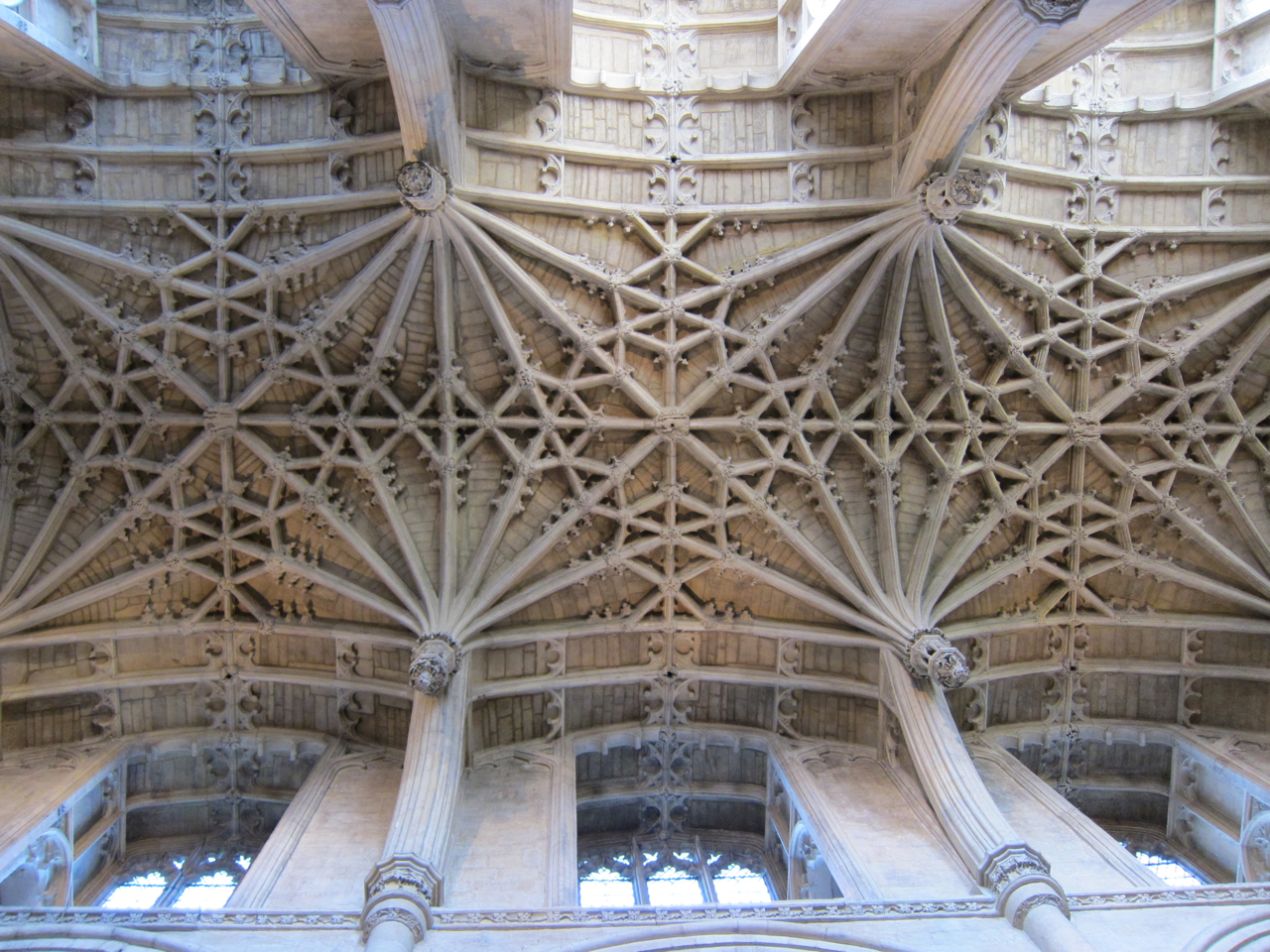
Here is a shot of the vault of the nave of the church. Note the elaborate clustered ribs, and, if you can, the hanging star-shaped pendants. If it looks at all familiar to you, it might be because this is the handiwork of William Orchard, who also made the vault for the Divinity School at Oxford, which was featured as the infirmary in the Harry Potter movies.


In the center of this stained glass window, with ornate tracery, you might be able to make out Thomas Becket being killed by the knights of Henry II.


This is a shot of the church tower from outside.


This staircase should remind you of Harry Potter. It was in the movies.


This is the tower at the entrance to Christ Church.


Some buildings around the large quadrangle of Christ Church. And a fountain in the middle.


Our last stop was outside Oxford Castle. Next to the castle was a mound, which used to support a tower. The tower and mound protected a well. Now it protects a great view of the city.


This is from the walk back from Oxford Castle. It's a shot of Cornmarket Street, a pedestrian street in the middle of the city where a lot of the shops (and people) are.


That is all.

Tuesday, May 3, 2011

Salsa with a Looming Danger of Lethargy

Something I forgot to talk about in my last post, but which has definitely been a fixture of the past week has been my discovery of social dancing at Oxford. I found, with some help from Heidi (Thorsen), two organizations at Oxford for social dancing - the Oxford University Dancesport Club and the Oxford University Salsa Society.

The first classes I went to were on Thursday down at St. Columba's Church, just a bit further west from Corpus Christi. There, a lady named Bea teaches Salsa and Rueda a couple days a week as part of Oxford University Dancesport. Heidi, Rebecca, and I showed up for an Intermediate Salsa class. Coming to the class, I was glad that Richard Powers stresses adaptability in all of his classes because this class was quite different from any salsa I had done before. The biggest difference is that they do Cuban style salsa, so the basic step and the feel of the dance are different. The biggest difference in the basic is that the men go back first and then forward, mirroring the women instead of traveling with the women. This means that the basic step has an interesting but challenging component of separating from your partner and then stepping into her. For the most part, I adjusted surprisingly quickly, but I also slipped into my old "LA style" habits pretty often. I would always catch myself and fix it, but it threw me off a lot. By the end of the salsa class, we had learned a couple of cool moves with some fancy spins in Cuban salsa and was pretty proud of myself.

Following the salsa class was a rueda class. Rueda, aparently, is basically Cuban salsa but where all the couples dance in a circle, one leader calls variations for everyone to do (like in square dancing), and couples often change partners. The main challenge of the dance, then, was not deciding which variations to lead but was simply knowing the names of all sorts of variations. Of course, I didn't know the names, so I sat it out and watched. Lucky Heidi and Rebecca are girls, so they just managed to fake the variations by following the men's leads. Rueda looked like a lot of fun, so I might try out the next class, when they will start the class over for the new term.

One of the take-aways from the classes, though, was that Richard Powers was more right than I ever knew. Every class I've taken with him, I thought he was belaboring the point that every dance teacher teaches differently a little too much. He always says that some dance teachers preach that their style is right and all the others are wrong. Well, this teacher, Bea, was just like the ultra-doctrinal, archetypal teacher he always described. She said that the handholds had to be just one way - any other way was the sign of a bad dancer. Steps had to be just one way; leads had to be just one way; fingers had to be just one way. Needless to say, I didn't like her too much. Still, the class was quite fun.

I didn't dislike her enough not to go to her beginner's class on Friday. I thought maybe I would fit in better there because I hadn't danced Cuban style before, but it ended up being a little too slow for me. As before, it was fun, and the other people in the class were nice. However, the class will be restarting from the very beginning this week, which will be a little too basic for me. If I take Bea's classes, I'll take intermediate salsa and maybe this rueda class.

My next social dance experience was at the Oxford University Dancesport social dance event of the week. Heidi and I trekked all the way out past the Radcliffe Science Library, the Physics building, and through a residential neighborhood to get to Lady Margaret Hall. When we got there, the only other couple there seemed to be practicing a ballroom dance routine that neither of us knew. There was an old guy with an iPod and some speakers. And that was pretty much it. Heidi and I danced to what he put on as best we could. We did some cross-step waltz, some cha-cha, and some swing. Some more couples showed up, but it would be hard to describe them as "social" seeing as they made no effort to interact with us or each other. After an hour of listening to music meant for ballroom dances and watching the other couples ballroom dance, we gave up trying to do our social dances and left. I don't know why it was billed as a "social dance" event.

And my most recent experience was more salsa, this time with the Oxford University Salsa Society. Yesterday, Heidi, Maricarmen, and I went to the Improvers class offered at Wesley Memorial Hall. This class taught the "LA style" that we were all more used to, but it was still pretty different from Richard Powers's classes at Stanford. The beginning half of the class focussed all on shine steps, kind of like solo, show-off-y steps where men and women aren't dancing with each other at all. They involved a lot of flair and focus on style that men in particular don't usually focus on. The teachers, a guy and a girl, were both good. They were much younger and more entertaining than the other lady. Unfortunately, I felt like the level of the class was at my level but that the other girls were often struggling. I am sure my unfamiliarity with the class had something to do with that, but I think the level of the students was just lower than at the other class. That may become a deciding factor in picking a class.

Right now, it looks like I might be doing a lot more salsa this quarter. There is also an Argentine tango class, but it conflicts with Bea's salsa class (the first one). Also, salsa is kind of more appealing because it is just more useful than tango. I don't have to choose between the salsa classes yet, so I may just keep going to both. It's just an issue of time and money, but both classes are relatively cheap. There are also salsa nights at various venues each week. Who would have thought - Oxford, England is pretty happening place for salsa dancing. And England never even owned any of Latin America.

I will write about May Day tomorrow, because I already wrote way too much about dancing today.

On the topic of lethargy, I just want to note that it has been setting in, and this worries me. What I call lethargy, some people may also call sloth, laziness, or exhaustion. Evidence of this is that this is only the second post in six days. SIX DAYS! I am mad at myself about this.

The main reason this worries me isn't that it's such a problem that I missed some posts. What worries me is that I have seen this kind of neglect from myself before. It is a specter that has haunted me throughout my time at Stanford. It tends to set in as I start getting bogged down in work, and it only worsens my workload. I feel tired and lazy, so I don't focus on doing my work like I should. Then my work doesn't get done, and I feel more stressed and exhausted and the cycle goes on. One of the worst parts about the lethargy setting in is that, if I am not vigilant I can end up spending some hours on the internet mindlessly  clicking on links. For some reason, this is what I end up doing when my mind is tired. Unfortunately, the rest I get from doing this doesn't equal the added pressure I have from having less time to do the things I need to do. Also, I just get more stressed out when I realize how much time I just wasted.

So, what's the real problem? And how do I fix it? I don't know.

One hypothesis is that the lethargy comes from physics problem sets. I trace the lethargy ghost back to around Wednesday of last week, when I started really working hard on my physics problem set. Doing problem sets is pretty stressful and tiring.

To compare studying physics with history, my two subjects for the term, I would compare them to gameshows. Reading for history is like that game where you stand in the plastic box and a bunch of money is released in front of a fan. You read more than you can hope to absorb and you try just to remember the main points and few things you found more interesting. The words go in your eyes, through your brain, and then most come right out again. It's like how the object of the game is to snatch as much money as you can in that plastic box - get the biggest bills and whatever else you can hold on to. Overall, it's a pretty fun game, and people come out of the box pretty happy.

Physics, on the other hand, is like Who Wants to be a Millionaire? You can start off by answering the easy questions first, but that doesn't get you more than a fraction of the way there. After that, it's really slow going. It would be great if you could jump to the $1,000,000 question and just answer that one, but you need to figure out every little step along the way before you can touch it. Some of those other questions are uninteresting and difficult, but it doesn't matter. While you answer the intermediate questions, you usually bang your head against a wall and then call a friend. And in the end, a lot of the time you don't truly understand the big question, but you move on anyway. People come out the other end of the game a little more sober than in the money box game, I think.

Point being - physics problem sets are stressful. Even if I can finish them in less time than history reading, history reading just doesn't wear me out the same way. It's not as demanding. That said, I haven't talked about writing papers. That's also not as fun as reading, but they usually come hand-in-hand.

What I haven't figured out, but should figure out, is how to make problem sets less stressful, or, at least, find out a reliable way to deal with the stress/lethargy that tends to follow problem set days.

The weird thing is that, once I start doing physics I don't have a problem going at it for hours on end. I do okay once I get into the physics groove. It's just sitting down to do it, and then regaining the energy it's drained from me after I stand back up that is the problem.

Of course, it might not be physics; it might be something entirely different. I worry that it's the byproduct of being in one place for too long. I get settled in and complacent. When I'm on the move, sometimes I maintain more energy for longer. I really enjoy traveling and haven't done any outside of Oxford yet. Then again, traveling can be very stressful and tiring, either if it doesn't go well or if I'm at it for too long.

Anyway, I don't know. Maybe writing about the lethargy will make it go away. Maybe I thought that I hadn't been writing because of the lethargy when, in fact, the lethargy hit me because I haven't been writing. We'll see soon enough.